Asia’s Best Night Markets for Food 2026
There is something almost magical about the way a night market comes alive after dark. Strings of bare bulbs flicker on, smoke curls up from sizzling grills, and the air thickens with the smell of garlic, lemongrass, and caramelised sugar all competing for your attention at once. Asia’s night markets are not just places to eat — they are the beating social heart of their cities, and in 2026 they remain some of the most exciting and affordable dining experiences on the planet. Whether you are plotting a dedicated food trip or simply want to eat well on a tight budget, this guide will walk you through the best markets, the dishes you absolutely cannot leave without trying, and all the practical details that make the difference between a chaotic scramble and a deeply satisfying evening.
Taipei‘s Night Market Scene: Where the Obsession Begins
Taiwan invented the modern night market as we know it, and Taipei still does it better than almost anywhere else. Shilin Night Market in the Shilin district is the city’s most famous, sprawling across two levels with dedicated indoor food courts and outdoor lanes that stretch for blocks. Show up around 7 p.m. on a weekend and you will hit peak energy — though if you want shorter queues, a Tuesday or Wednesday evening works just as well. Raohe Street Night Market on the eastern side of the city is smaller, more manageable, and arguably has better food per square metre. Start at the famous pepper pork bun stall right at the entrance — the line moves quickly and the buns, baked in a clay tandoor oven, are extraordinary at around NT$55 (roughly USD $1.70).
At Shilin, the things you must order include oyster vermicelli in a thick sweet potato starch sauce, scallion pancakes stuffed with egg, and the enormous fried chicken cutlet that has become something of a Taiwanese icon. Stinky tofu polarises visitors, but locals eat it as casually as chips — deep-fried with pickled cabbage and chilli sauce, it tastes far less terrifying than it smells. Most stalls are cash only, so carry plenty of New Taiwan Dollars. ATMs are plentiful throughout both markets. If you want context and insider recommendations, Viator and GetYourGuide both list well-reviewed Taipei night market food tours that include translation help and hidden-stall access for around USD $35 to $50 per person.
Bangkok‘s Street Food Markets: Late Nights and Bold Flavours
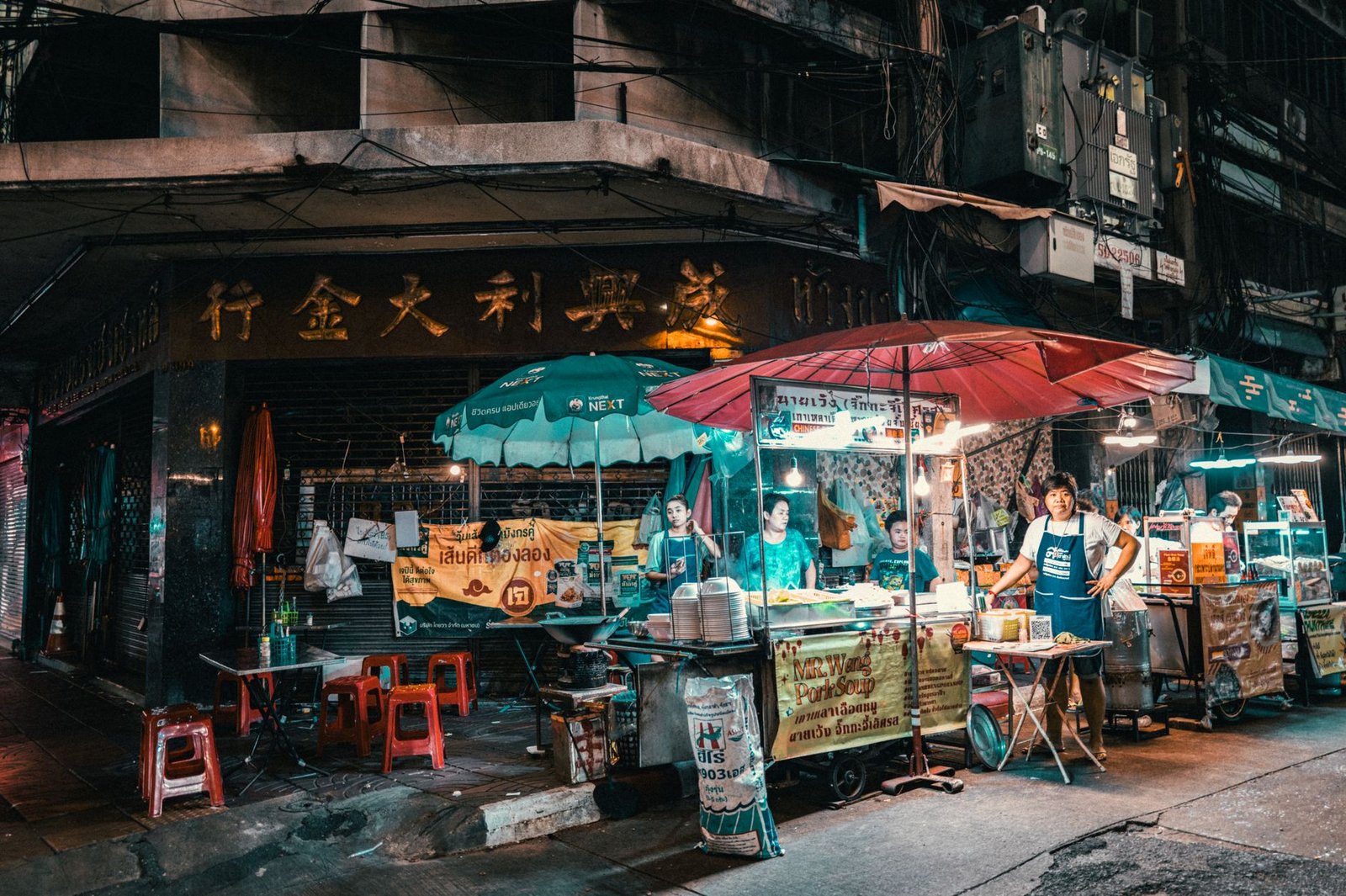
Bangkok’s relationship with street food is long, complicated, and absolutely delicious. The city has seen some famous market closures over the years, but new hubs have filled the gaps with enthusiasm. Talad Rot Fai (Train Night Market) has two locations — Srinakarin and Ratchada — and both are excellent for a mix of street food, vintage goods, and an atmosphere that feels more like a festival than a market. Or Tor Kor Market near Chatuchak, while technically a daytime fresh market, spills into evening hours and stocks some of the finest prepared foods in the city, including grilled meats, mango sticky rice made with premium Khao Dawk Mali rice, and regional specialties you rarely see at tourist-facing spots.
What to order in Bangkok depends entirely on how adventurous you feel. Pad kra pao (minced pork or chicken stir-fried with holy basil and a fried egg) served on jasmine rice for around 60 to 80 THB (USD $1.70 to $2.30) is a perfect entry point. Grilled satay skewers with peanut sauce, boat noodles at the floating markets nearby, and mango with sticky rice drizzled in coconut cream are all essential. Bangkok is more card-friendly than Taipei, particularly at larger food courts and market complexes, but smaller street vendors will still want cash. Bargaining is not standard at food stalls — prices are typically fixed and displayed — but a friendly smile and a phrase or two of Thai will always earn you a warmer welcome.
Chiang Mai After Dark: Northern Thai Flavours Done Right
Chiang Mai operates on a different rhythm from Bangkok, and its night markets reflect that slower, more artisanal energy. The Saturday Walking Street on Wualai Road and the Sunday Walking Street on Thanon Nimmanhemin are the two anchors of the city’s evening food culture. Both markets combine northern Thai handicrafts with serious street food, and the Sunday market in particular stretches for nearly a kilometre through the old city. Arrive around 6 p.m. to walk the full length before it gets too crowded.
Northern Thai cuisine is distinct from what you find in Bangkok, and the night markets are the best place to explore that difference. Khao soi — a rich coconut curry broth with egg noodles, crispy noodle fritters on top, and your choice of protein — is the dish Chiang Mai is most famous for, and small market stalls typically serve it for 60 to 80 THB. Sai oua, the herby northern sausage packed with lemongrass, galangal, and kaffir lime leaves, is grilled fresh and costs around 30 THB per link. Nam prik noom, a roasted green chilli dip served with sticky rice and raw vegetables, is another northern specialty worth seeking out. Guided food tours through GetYourGuide offer excellent small-group evening walks that cover the Sunday market and often include a cooking demonstration, making them especially worthwhile for first-time visitors to the city.
Kuala Lumpur: Asia’s Most Diverse Night Market Table
Kuala Lumpur’s cultural diversity — Malay, Chinese, Indian, and Peranakan traditions all intersecting — makes its night markets some of the most culinarily rich in Southeast Asia. The Jalan Alor food street in Bukit Bintang is the most iconic evening dining destination in the city, lined with Chinese-Malaysian restaurants and hawker stalls that set plastic tables and chairs right out onto the road. Despite its tourist popularity, the food quality remains high and prices are honest. Char kway teow, the wok-fried flat rice noodles with prawns, Chinese sausage, and bean sprouts cooked over fierce charcoal heat, is the dish that makes regulars come back repeatedly — expect to pay around 12 to 18 MYR (USD $2.50 to $4.00).
For a more local experience, head to the Chow Kit wet market area in the evenings or explore the Kampung Baru Malay neighbourhood where nasi lemak — coconut rice with anchovies, peanuts, cucumber, and sambal — is served wrapped in banana leaf at stalls that have been there for decades. Petaling Street in Chinatown comes alive at night with durian vendors, roast duck stalls, and herbal teas. Kuala Lumpur is more card-friendly than most Southeast Asian cities, and GrabPay is widely accepted even at market stalls. Bargaining for food is not expected, though it is perfectly normal at clothing and souvenir sections of the same markets.
Taichung’s Fengjia Night Market: Taiwan’s Biggest and Most Creative
While Taipei gets most of the international attention, food-obsessed travellers in Taiwan will tell you that Fengjia Night Market in Taichung is the country’s true laboratory for night market innovation. Officially the largest night market in Taiwan by visitor numbers, Fengjia is where vendors debut new dishes that eventually spread across the island. The bubble tea concept was popularised in Taichung, and the market continues that tradition of experimentation today. Expect to find cheese-filled hot dogs wrapped in tornado-cut potatoes, mochi ice cream in unexpected flavours, Taiwanese beef noodle soup ladled out of enormous pots, and grilled corn slathered in butter and soy sauce.
The market is a short taxi or Uber ride from Taichung High Speed Rail station, making it very accessible as a day trip from Taipei. Go between 6 and 10 p.m. for the best atmosphere. Prices here are slightly lower than in Taipei — most snacks fall between NT$40 and NT$80 — and the crowd is predominantly local university students and Taiwanese families, which keeps the energy authentic and lively. Cash is essential at Fengjia; very few stalls have card readers.
Practical Tips for Night Market Success Across Asia
Cash, Cards, and Local Currency
- Taiwan: Carry New Taiwan Dollars. Most street stalls are cash only. Convenience stores (7-Eleven, FamilyMart) have reliable international ATMs.
- Thailand: Thai Baht is essential for market vendors. Airport exchange counters offer reasonable rates; avoid hotel exchanges.
- Malaysia: Malaysian Ringgit is standard. GrabPay and Touch N Go e-wallets are widely accepted in KL.
- Withdraw larger amounts less frequently to minimise ATM fees.
Timing, Bargaining, and Staying Safe
- Most markets hit their best energy between 7 and 9 p.m. — not too crowded, full selection still available.
- Bargaining is acceptable for clothing, accessories, and crafts but not for prepared food.
- Keep a small day bag in front of you in crowded areas.
- Look for stalls with high turnover — a busy stall means fresh ingredients and fast cooking, which also means safer food.
- Bring a small bottle of hand sanitiser; street dining by definition means limited handwashing options.
- Booking a guided food tour through Viator or GetYourGuide is especially worthwhile on your first night in a new city — guides know which stalls are exceptional that week, handle language barriers, and often negotiate tastings you would not find alone.
Asia’s night markets in 2026 are as vibrant, delicious, and welcoming as ever, and they remain one of the single best arguments for slow, food-first travel. From the experimental snack culture of Fengjia to the layered spice of Kuala Lumpur’s Jalan Alor, each market tells the story of its city through food in a way that no restaurant ever quite can. Plan your evenings around them, bring cash, go hungry, and do not be afraid to point at something sizzling that you cannot name — that is usually where the best memories are made. Ready to start planning your night market adventure? Browse our curated Asia food itineraries on FoodTourTrails.com and find the perfect guided tour to make every bite count.
Book a Food Experience in Top Destinations
Handpicked experiences — book with free cancellation and instant confirmation.
Explore More Food Tours
Guides for the cities in this article:
- Chiang Mai Food Tour Guide (Thailand)
- Taipei Food Tour Guide (Taiwan)
- Kuala Lumpur Food Tour Guide (Malaysia)
- Bangkok Food Tour Guide (Thailand)
Frequently Asked Questions
What is the best night market in Asia for street food in 2026?
Shilin Night Market in Taipei remains a top contender, famous for its giant fried chicken cutlets, oyster vermicelli, and bubble milk tea. Yaowarat Road in Bangkok's Chinatown is equally celebrated, offering fresh seafood grilled to order and legendary pad see ew stalls. For 2026, Jonker Street Night Market in Melaka, Malaysia has also surged in popularity thanks to its unique Peranakan-Chinese fusion dishes.
Are night markets in Asia safe to eat at as a tourist?
Generally yes, especially at well-established markets like those in Taiwan, Singapore's Newton Food Centre, and South Korea's Gwangjang Market, where food hygiene standards are regulated and consistently enforced. Look for stalls with high customer turnover, as food is freshly prepared rather than sitting out for hours. It's wise to carry hand sanitizer and stick to cooked-to-order dishes if you have a sensitive stomach.
How much money should I budget per night at an Asian night market?
Most travelers spend between USD $10–$20 per person for a satisfying meal with drinks at markets in Thailand, Vietnam, and Malaysia. Taiwan and Japan markets tend to run slightly higher, with a full evening of tasting costing around USD $20–$35 per person. Always carry local cash, as many individual stalls do not accept cards or mobile payments from foreign apps.
What are the must-try dishes at Vietnam's famous night markets?
At Hội An Night Market, don't miss bánh mì stuffed with locally sourced fillings, white rose dumplings, and fresh cao lầu noodles unique to the region. Đà Lạt Night Market is renowned for its bánh tráng nướng, often called Vietnamese pizza, and warm sữa đậu nành soybean milk. In Hanoi's Old Quarter night market, bún chả grilled pork with rice noodles and egg coffee are absolute essentials.
What time do Asian night markets typically open and close?
Most night markets open between 5:00 PM and 7:00 PM local time, with peak crowds arriving after 8:00 PM when locals finish work and dinner rush begins. Markets in Taiwan and Thailand typically run until midnight or 1:00 AM, while some in Malaysia and Indonesia stay lively until 2:00 AM on weekends. Arriving slightly before peak hours around 7:00 PM gives you shorter queues and the freshest ingredients before popular items sell out.