
Best Street Food Cities in the World 2026
There is no greater way to understand a city than through its street food — the sizzling woks at midnight, the hand-pressed tortillas at dawn, the paper cones of roasted chestnuts passed between cold hands on a cobblestone corner. In 2026, food travel is booming, and these ten cities are calling to every traveler who believes the best meals happen standing up, wallet-light, surrounded by locals. Pack your appetite and your sense of adventure — this is the definitive list of the world’s best street food cities right now.
Bangkok, Thailand
Bangkok has worn the crown of street food capital for decades, and in 2026 it shows absolutely no sign of surrendering it. The Thai capital is a city that breathes through its food stalls, where pad kra pao (stir-fried basil pork) hisses in blackened woks at three in the afternoon and boat noodles — rich with pork blood broth and tender braised meat — are served in tiny bowls so you order five or six at a time. Som tum, the fiery green papaya salad pounded to order in a clay mortar, is eaten on every corner, and mango sticky rice piled with coconut cream is the city’s most beloved dessert, enjoyed at any hour without judgment.
Yaowarat Road in Chinatown remains Bangkok’s most iconic late-night eating strip, where roasted duck and oyster omelets share sidewalk space with whole steamed crabs. Chatuchak Weekend Market feeds thousands every Saturday and Sunday, while the quieter lanes of Silom and Ari neighborhoods reward those willing to wander. Don’t miss the riverside markets near Pak Khlong Talat, the flower market district, where vendors sell bowls of boat noodles to workers before the sun is fully up.
Explore our full Bangkok food guide →
Istanbul, Turkey
Istanbul is a city built on the crossroads of civilizations, and its street food is the most delicious proof of that history. A fresh simit — the sesame-crusted bread ring sold from red carts across the city — costs almost nothing and tastes like everything a breakfast should be. Balık ekmek, a grilled fish sandwich served from rocking boats moored at Eminönü, is one of the world’s great street meals, eaten on the waterfront with a squeeze of lemon and a side of pickled vegetables. Then there is kokoreç, the spiced lamb intestine sandwich that divides visitors but unites locals in fierce loyalty.
The Kapalıçarşı, or Grand Bazaar, hides incredible food in its outer corridors, but the real eating happens in the surrounding streets of Beyazıt and Eminönü. Kadıköy on the Asian side has become the city’s most exciting food neighborhood, where meyhane culture meets modern street food creativity. Istiklal Avenue in Beyoğlu buzzes at midnight with döner stands, mussel carts selling midye dolma stuffed with spiced rice, and vendors hawking freshly pressed pomegranate juice from towering machines.
Explore our full Istanbul food guide →

Singapore
Singapore turned its street food culture into a national institution when its hawker centres were awarded UNESCO Intangible Cultural Heritage status, and eating here feels like participating in something genuinely sacred. Hainanese chicken rice — silky poached chicken served over fragrant pandan-scented rice with three dipping sauces — is the unofficial national dish, but laksa, a coconut-curry noodle soup of staggering depth, runs it a very close second. Char kway teow, flat rice noodles wok-fried with Chinese sausage, cockles, and egg over blistering heat, achieves a smoky complexity that no home kitchen can replicate.
Maxwell Food Centre in Tanjong Pagar is arguably the most famous hawker centre in the world, home to the legendary Tian Tian Chicken Rice stall where lines form before opening. Old Airport Road Food Centre in Kallang is beloved by locals for its extraordinary variety and old-school atmosphere. Lau Pa Sat in the CBD transforms at night when its surrounding streets close to traffic and satay vendors fire up hundreds of skewers simultaneously, filling the air with the sweet smoke of grilling meat.
Explore our full Singapore food guide →
Mexico City, Mexico
Mexico City’s street food scene is an argument made in masa, chili, and smoke — an ancient culinary tradition that runs so deep it was recognized by UNESCO decades before most cities started paying attention. Tacos al pastor, thin-sliced pork shaved from a vertical spit and served on a tiny corn tortilla with pineapple, onion, and cilantro, are eaten at every hour here, but never more joyfully than at two in the morning. Tlayudas, tamales wrapped in banana leaves, tlacoyos stuffed with black beans, and the extraordinary complexity of mole negro are just a fraction of what the city offers its hungry visitors.
Mercado de la Merced is the city’s largest traditional market and one of its most overwhelming sensory experiences — stalls of dried chiles, fresh herbs, and bubbling pots of pozole stretch on seemingly without end. Coyoacán’s weekend market draws locals and tourists alike for its quesadillas made with blue corn masa cooked on a comal. The streets around Tepito and the historic centro are some of the best places on earth to eat tacos de canasta, steamed basket tacos sold from bicycle carts for almost nothing.

Explore our full Mexico City food guide →
Marrakech, Morocco
Marrakech feeds its visitors through spectacle and spice in equal measure, making the act of eating here feel theatrical in the best possible way. Djemaa el-Fna, the city’s central square, transforms each evening into one of the world’s greatest open-air restaurants, where smoke from dozens of grills rises together into a fragrant cloud above the medina. Merguez sausages, harira soup thick with chickpeas and tomatoes, sheep’s head for the adventurous, and msemen flatbreads drizzled with argan oil honey are all eaten here under the stars. The tagine — slow-cooked lamb with preserved lemon, olives, and ras el hanout — may be Moroccan cuisine’s most famous export, but in Marrakech it tastes like a completely different thing entirely.
The souks surrounding the medina hide dozens of small food stalls where locals eat snail soup from communal bowls, a briny, herby broth considered a cure for almost everything. Mellah, the old Jewish quarter, has excellent hole-in-the-wall eateries serving briouats, the flaky pastry parcels filled with spiced minced meat or almond paste. For the best street breakfast in the city, head to the small cafés around Bab Doukkala gate before eight in the morning for msemen, amlou dipping sauce, and a glass of sweet mint tea.
Explore our full Marrakech food guide →
Hanoi, Vietnam
Hanoi’s street food is quieter and more refined than the chaotic abundance of cities further south, but no less extraordinary. Pho bo, the city’s signature beef noodle soup, is a study in restrained perfection — clear star anise-scented broth, silky rice noodles, thin slices of beef, and a handful of herbs eaten at small plastic tables on the pavement at six in the morning. Bun cha, charcoal-grilled pork patties served with vermicelli, fresh herbs, and a sweet fish sauce broth for dipping, became internationally famous when Anthony Bourdain shared a bowl here with Barack Obama, and it absolutely deserves every bit of the attention.
The Old Quarter is the historic heart of Hanoi’s street food culture, where each narrow lane historically specialized in a different trade and now specializes in a different flavor. Hang Be market in the early morning is extraordinary for banh mi and fresh bánh cuốn, steamed rice rolls filled with minced pork and wood ear mushrooms. Ta Hien Street, known as Beer Corner, comes alive at night with locals drinking bia hơi, the cheap draft beer brewed fresh daily, alongside plates of grilled corn and nem ran spring rolls.
Explore our full Hanoi food guide →
Naples, Italy
Naples invented pizza and has never stopped perfecting it, which alone would be enough to earn its place on any serious food list. But the city’s street food culture runs far deeper than its most famous export. Cuoppo, a paper cone filled with fried seafood — tiny squid, shrimp, and whitebait — is eaten walking through the Quartieri Spagnoli without napkins and without apology. Frittatina di pasta, deep-fried pasta cakes bound with béchamel and studded with salami, are sold from friggitorie alongside pizza fritta, the fried calzone that predates the baked version and remains the preferred choice of many Neapolitans.
The historic center, a UNESCO World Heritage site in its own right, is threaded with streets so narrow that the buildings nearly touch overhead, and it is in these vicoli that the best eating happens. Via dei Tribunali and Via dell’Anticaglia are dense with pizzerias where Margherita DOC pizza is served on metal trays at communal tables. The Mercato di Porta Nolana near the train station is the city’s best market for fresh seafood, and the surrounding streets are ideal for sfogliatella, the shell-shaped pastry filled with ricotta and orange that is Naples’s greatest contribution to breakfast.
Explore our full Naples food guide →
Tokyo, Japan
Tokyo approaches street food with the same obsessive precision it brings to everything, and the results are quietly, consistently extraordinary. Yakitori — skewered chicken grilled over binchotan charcoal and glazed with tare sauce — is eaten standing at counters under the railway arches of Yurakucho and Shimbashi, the smoke rising into the evening air alongside the sound of the Yamanote line overhead. Taiyaki, the fish-shaped waffles filled with sweet red bean paste or custard, are pressed to order in cast iron molds on busy shopping streets. Ramen, though often eaten indoors, is fundamentally a street food spirit: fast, deeply personal, and available at all hours.
Tsukiji Outer Market remains one of the world’s great morning food destinations despite the inner wholesale market’s relocation, where fresh sea urchin, grilled scallops, and tamagoyaki rolled egg are eaten walking between the stalls. Asakusa’s Nakamise shopping street leads to one of the best concentrations of traditional Japanese street snacks in the country — ningyo-yaki cakes, age-manju fried buns, and freshly pounded mochi. Harajuku’s Takeshita Street is where younger food trends surface first, from rainbow cotton candy to towering crepes filled with matcha cream.
Explore our full Tokyo food guide →
Mumbai, India
Mumbai feeds ten million people through its streets every single day, and the sheer velocity and variety of that feeding makes it one of the most exciting food cities on earth. Vada pav — a spiced potato fritter tucked into a soft bread roll with green chutney and dried garlic chutney — is called the Mumbai burger and is eaten by everyone from schoolchildren to stockbrokers. Pav bhaji, a rich tomato and vegetable mash served with butter-soaked bread rolls, originated here and remains the city’s most beloved communal street meal. Bhel puri, the sweet-sour-spicy puffed rice snack tossed with tamarind chutney and diced vegetables, is eaten on the seafront at Marine Drive as the sun drops into the Arabian Sea.
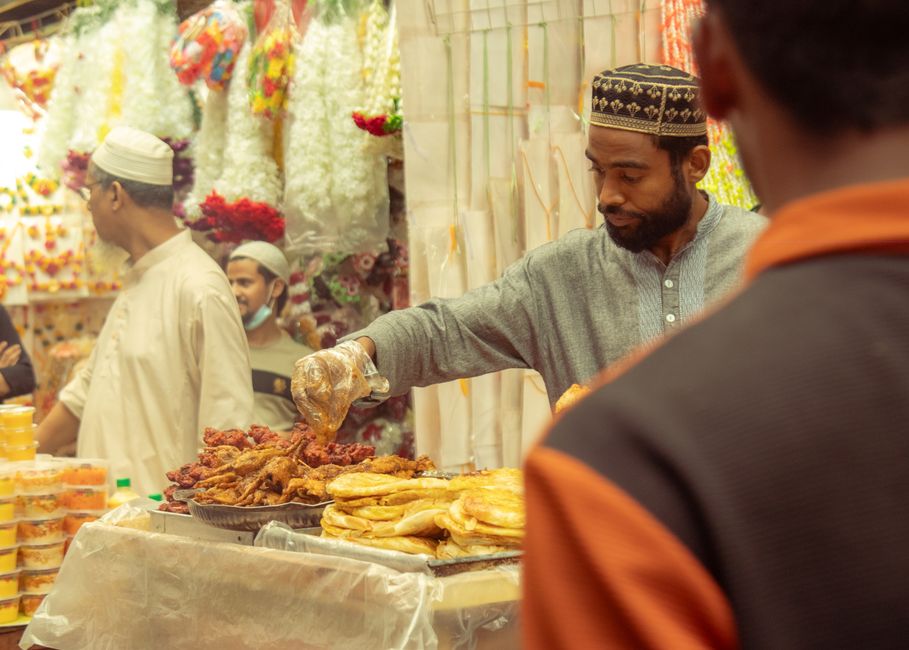
Juhu Beach is the city’s most iconic street food destination, where vendors line the sand with carts of pani puri, ragda pattice, and sev puri, all of which need to be eaten immediately before the puri softens. Mohammed Ali Road in the Muslim quarter of Dongri becomes a night food festival during Ramadan that draws visitors from across the country for nihari, kebabs, and the extraordinary Bohri thali. Crawford Market, built by the British in 1869, anchors one of the densest concentrations of street eating in Asia in the lanes surrounding its grand facade.
Explore our full Mumbai food guide →
Penang, Malaysia
Penang punches so far above its weight as a food destination that seasoned travelers routinely rank it above cities ten times its size, and the residents of George Town take a pride in their culinary heritage that borders on fierce. Char kway teow here — and Penang residents will insist it is nothing like Singapore’s version — is wok-fried with duck eggs, Chinese lap cheong sausage, and a generous handful of cockles over the kind of ferocious flame that creates the smoky wok hei that defines great hawker cooking. Asam laksa, a sour fish-based noodle soup tamarind-bright with mackerel and torch ginger flower, is the dish that best captures Penang’s unique Peranakan heritage, the fusion of Chinese and Malay cultures that makes the island’s food unlike anything else in Southeast Asia.
Gurney Drive Hawker Centre overlooking the sea is the most famous gathering point for Penang food, where multiple generations of the same families have operated the same stalls for decades. Lorong Baru New Lane hawker street comes alive at night with some of the best prawn mee, popiah fresh spring rolls, and oyster omelettes on the island. The streets of George Town’s UNESCO-protected historic core are themselves a food tour — around almost every corner there is a coffeeshop where kopi brewed the old Hainanese way is served in glasses alongside toasted bread thick with kaya coconut jam and cold salted butter.
Explore our full Penang food guide →
The world is vast, delicious, and endlessly rewarding for those willing to follow their appetite into its most vibrant corners. Whether you start with a bowl of pho in Hanoi at sunrise or a slice of pizza fritta in Naples at midnight, every journey on this list promises to change the way you think about food, culture, and the beautiful act of eating with strangers. Bookmark your favorites, build your itinerary, and let the street food of the world be your guide in 2026.
Book a Food Experience in Top Destinations
Handpicked experiences — book with free cancellation and instant confirmation.
Explore More Food Tours
Guides for the cities in this article:
- Mumbai Food Tour Guide (India)
- Marrakech Food Tour Guide (Morocco)
- Penang Food Tour Guide (Malaysia)
- Hanoi Food Tour Guide (Vietnam)
- Singapore Food Tour Guide (Singapore)
- Istanbul Food Tour Guide (Turkey)
Frequently Asked Questions
Which city on this list is best for first-time street food travelers?
Bangkok is an excellent starting point because street vendors are concentrated in night markets and busy areas like Chinatown, making it easy to explore without getting overwhelmed. The food is generally safe from established vendors, and prices are incredibly affordable so you can try many dishes without breaking the bank.
Do I need to speak the local language to order street food?
Not necessarily—most successful street food cities have vendors accustomed to tourists and many use picture menus or hand gestures. In major cities like Istanbul and Mexico City, you'll find English speakers at popular stalls, though learning a few key phrases always helps and is appreciated by vendors.
Is street food safe to eat, and should I be worried about getting sick?
Street food from busy, popular stalls with high turnover is generally safer than you might think, as vendors rely on reputation and repeat customers. Stick to hot foods cooked fresh in front of you, avoid raw items if you're unsure about water quality, and choose vendors with visible cleanliness and long queues of locals.
What's the best time of year to experience street food in these cities?
Most street food cities are best visited during their cooler months or shoulder seasons when night markets are most active and comfortable to navigate. However, cities like Bangkok and Ho Chi Minh City have year-round street food scenes—just expect to eat during early morning or late evening to avoid extreme heat.
How much budget should I allocate daily for street food?
In Asian street food cities like Bangkok and Hanoi, you can eat incredibly well for $5-15 per day, while Middle Eastern cities like Istanbul average $10-20 daily. Western cities with street food scenes typically cost $15-30 per day, making street food an economical way to experience authentic local cuisine.