Athens Food Tour – Best Local Food & Restaurants
Athens, Greece: The Ultimate Food Guide
Athens is one of the world’s oldest cities, and its food culture runs just as deep as its legendary history. From the ancient agoras where merchants once traded olive oil and wine to the buzzing street food stalls of Monastiraki, eating in Athens feels like moving through time. This is a city where grandmothers still make spanakopita from scratch, where fishermen deliver their catch directly to taverna owners before sunrise, and where a simple meal shared with strangers can become the thing you remember most about your entire trip. The food here isn’t just good. It’s loaded with meaning.
The History of Athenian Food Culture
The story of Athenian food begins more than 2,500 years ago. Ancient Greeks understood that food wasn’t just fuel — it was civilization. The philosopher Archestratus, often called the world’s first food critic, wrote the poem Hedypatheia (Life of Luxury) around 330 BC, cataloging the finest ingredients and dishes across the Mediterranean world. Olive oil, wine, bread, fish, legumes, and honey formed the backbone of the ancient Athenian diet. What’s remarkable is how little that template has changed.
The Byzantine era layered new influences into Athenian cooking, introducing spices from the East and more elaborate preparation techniques. Then came four centuries of Ottoman rule, which left permanent marks on the local food landscape. Moussaka, tzatziki, baklava — all carry clear Ottoman DNA, though Athenians have made them entirely their own. The 20th century brought another wave of change. Greek refugees arriving from Asia Minor after the 1922 population exchange brought flavors from Smyrna, Constantinople, and beyond. Spicy soutzoukakia meatballs and rich eggplant imam bayildi entered the mainstream Athenian kitchen during this period, and they never left.

Today, Athens stands at a genuinely exciting crossroads. A new generation of chefs, many trained in Paris, Copenhagen, and New York, are returning home to reinvent Greek cuisine with modern techniques while honoring ancient ingredients. The city earned its first Michelin stars relatively recently, yet its greatest food experiences still happen in decades-old tavernas where the menu is written on a chalkboard and the wine comes from an unlabeled carafe. That tension between tradition and innovation is precisely what makes eating in Athens so endlessly compelling.
Must-Try Foods in Athens
1. Souvlaki and Pita Wrap
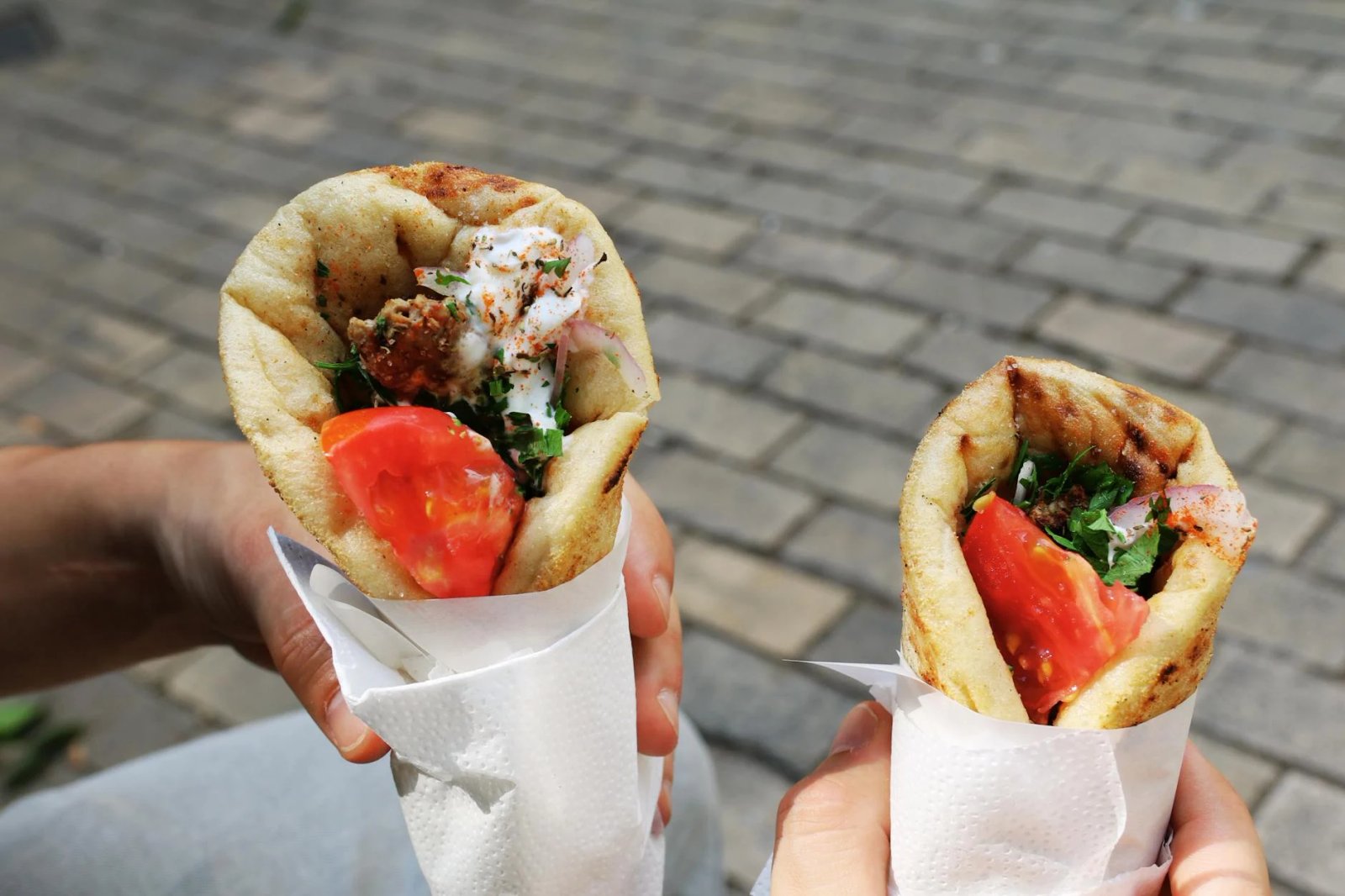
No food better captures the democratic soul of Athens than souvlaki. Skewers of marinated pork or chicken, grilled over charcoal until lightly charred at the edges, are either eaten straight off the stick or tucked into a thick, pillowy pita with fresh tomatoes, onions, tzatziki, and a generous scattering of paprika. At its best, a souvlaki pita costs around three euros. It will embarrass restaurants charging ten times the price. Don’t leave Athens without eating at least one — ideally several, from different spots. The best versions come from dedicated souvlaki shops called souvlatzidika, where the pork is seasoned simply with oregano, lemon, and olive oil, and the pita gets a brief turn on the grill before it’s loaded up. That small detail — the slightly crisped pita — makes a real difference.
2. Spanakopita
Spanakopita is the definitive Greek savory pastry, and Athens is where you’ll find it at its finest. Layers of paper-thin, hand-stretched phyllo dough encase a filling of wilted spinach, crumbled feta, fresh dill, spring onions, and eggs. Done properly, it’s shatteringly crisp on the outside and creamy, herbaceous, and salty within. Every bakery in Athens makes its own version, and the differences are startling — some brush the phyllo with butter, others use olive oil, and the spinach-to-feta ratio changes the character entirely. Buy a slice from a traditional bakery early in the morning, straight from the oven while the butter is still warm and fragrant. This is breakfast in Athens. It is magnificent, and it costs almost nothing.
3. Grilled Octopus
Outside a good seafood taverna, you’ll often see octopuses hanging in the sun on a washing line, slowly drying over hours. That process draws out moisture and concentrates flavor before the octopus ever touches the grill. What comes off the charcoal is extraordinary: chewy yet tender, smoky, sweet, intensely oceanic, finished with olive oil, a squeeze of lemon, and sometimes a splash of red wine vinegar. It’s typically served as a mezze, sliced into pieces and eaten slowly while sipping ouzo or tsipouro. The ritual matters as much as the dish. Don’t rush it.
4. Moussaka
Greece’s most famous baked dish is far more nuanced than its international reputation suggests. A proper Athenian moussaka has three distinct, labor-intensive layers: a base of sliced eggplant that’s been salted, pressed, and roasted to remove bitterness; a middle layer of ground lamb or beef cooked slowly with onions, tomatoes, cinnamon, allspice, and red wine; and a thick, cloud-like béchamel on top, enriched with egg yolks and a generous grating of kefalotyri cheese. It’s baked until the béchamel forms a golden, slightly wobbling crust. Crucially, it should be served warm rather than piping hot — that resting time lets the flavors settle and deepen. The version you get at a tourist-facing restaurant near the Acropolis will not taste the same as one made by someone who’s been following the same recipe for forty years. Seek out the latter.
5. Fresh Loukoumades
These ancient Greek honey doughnuts may well be the oldest street food in the world. Historical records suggest that athletes at the original Olympic Games were rewarded with loukoumades as a prize. Thousands of years later, small shops across Athens are still dropping spoonfuls of light, yeasted batter into bubbling oil, fishing out the golden puffs when they’re the color of autumn leaves, and cascading them with warm thyme honey and cinnamon. Modern shops have added toppings like Nutella and crushed pistachios, and honestly, even the purists quietly enjoy some of those variations. But the traditional version is hard to beat. Eat them immediately, standing at the counter. The contrast between the crisp shell and the airy, steam-filled center disappears within minutes.
6. Fasolada
Often called the national dish of Greece, fasolada is a humble white bean soup that proves powerful flavors require no complexity. Dried white beans are soaked overnight, then simmered slowly with olive oil, celery, carrots, onions, and tomatoes until they’re creamy and have absorbed everything around them. The soup is finished with a generous pour of raw extra-virgin olive oil, which adds a grassy, peppery richness. It’s historically the food of poor Athenians, eaten through wars and occupations and economic crises, and that resilience is present in every bowl. Finding it on a restaurant menu these days is increasingly rare, which makes encountering it all the more worthwhile. Look for it in old-fashioned lunch spots called mageiria, which serve rotating daily specials of traditional cooked dishes. Go at noon — they often run out by early afternoon.
Best Neighborhoods for Food in Athens
Monastiraki and Psiri
These two adjacent neighborhoods form the chaotic, glorious center of Athens street food culture. Monastiraki’s square and the streets radiating out from it are where you go for the city’s best souvlaki and pita wraps — Thanasis and Bairaktaris are legendary names, but plenty of smaller shops nearby match them in quality and have shorter queues. On Sundays, the flea market sprawls through the area, filling the streets with vendors selling antique furniture, vintage clothing, and fresh pomegranates. Eating while you browse isn’t just acceptable here — it’s expected. Psiri, a short
Book a Food Tour in Athens
Join a small-group food tour and taste the best of Athens with a local guide. Skip the tourist traps — discover the hidden spots only locals know.




Book a Food Experience in Athens
Handpicked experiences — book with free cancellation and instant confirmation.
Explore More Food Tours
More food guides from Greece:
- Corfu Food Tour Guide
- Mykonos Food Tour Guide
- Santorini Food Tour Guide
- Thessaloniki Food Tour Guide
You might also enjoy:
- Hvar Food Tour Guide (Croatia)
- Split Food Tour Guide (Croatia)
Featured in:
Frequently Asked Questions
How much does a food tour in Athens cost?
Food tours in Athens typically range from €25 to €80 per person for a guided group tour. Private tours and premium culinary experiences can cost more, while self-guided food walks are often free or low-cost.
How long do food tours in Athens last?
Most guided food tours in Athens last between 2 and 4 hours and include multiple tasting stops. Walking food tours tend to run around 3 hours, while sit-down dining experiences may last longer.
What local dishes should I try on a Athens food tour?
A food tour in Athens is the best way to discover authentic local specialties. Your guide will take you to street food markets, traditional restaurants, and neighbourhood gems that locals love — dishes you would never find on your own.
What is the best area for street food in Athens?
The best areas for street food and local cuisine in Athens are usually found in the old town, central food markets, and traditional neighbourhoods away from the main tourist hotspots. A local food guide will show you exactly where to go.
Are food tours in Athens suitable for people with dietary restrictions?
Most food tour operators in Athens can accommodate vegetarian, vegan, halal, and gluten-free diets with advance notice. Always inform your guide of any dietary requirements when booking so they can plan the best route for you.
Planning more than food in Athens? AthensToursHQ covers the Acropolis, day trips, neighbourhoods and the best tours & experiences in the city. Visit the Athens guide →