
How to Find Authentic Local Food (Not Tourist Traps)
You’ve done everything right. You researched the destination, packed light, and arrived hungry and excited. Then you sat down at a charming restaurant near the main square, ordered the “traditional” dish your guidebook recommended, and received something that tasted suspiciously like it came from a frozen bag. Sound familiar? Tourist trap restaurants are everywhere, and they’ve gotten remarkably good at looking authentic. The good news is that finding genuinely delicious, locally loved food isn’t about luck or insider connections — it’s about knowing a few simple tricks that separate the real deal from the overpriced performance. Whether you’re wandering through the alleyways of Palermo, the street markets of Bangkok, or the neighborhood bodegas of Mexico City, this guide will help you eat the way locals actually eat, every single time.
Walk Away From the Sights (Literally)
The single most reliable strategy for finding authentic food is deceptively simple: use your feet. Tourist trap restaurants survive on foot traffic from people who are already tired, already hungry, and already standing right there. The moment you commit to walking at least two full blocks away from any major tourist attraction — a cathedral, a famous square, a well-known museum — the quality of your food options rises dramatically and the prices drop just as fast.
Think about it this way. In Rome, the restaurants within a two-block radius of the Trevi Fountain are paying some of the highest rents in the city. They need to turn tables fast and cook in volume. But walk four blocks north into the Prati neighborhood and suddenly you’re finding trattorias where Roman families have been eating Sunday lunch for generations. The carbonara costs half as much and tastes twice as good.

This rule applies almost universally. In Barcelona, walk away from Las Ramblas into the Eixample or Gràcia neighborhoods. In Istanbul, step back from the Grand Bazaar entrance and find the tea shops and kebab counters where the vendors themselves eat lunch. Distance from tourist density is your best compass.
Read the Signs — And the Absence of Them
Restaurant signage tells you an enormous amount before you ever touch a menu. Here are the signals worth paying attention to:
- No English on the sign: If the restaurant name and any exterior text is entirely in the local language, that’s a very good sign. It means the owner built their business for local customers, not passing tourists.
- Handwritten menus: A chalkboard or handwritten daily menu means the food changes based on what’s fresh and available. A laminated, multi-page menu with forty dishes in six languages means the kitchen is working from a stockpile of ingredients designed to last.
- No photos on the outside menu: The laminated photo menu mounted on a podium outside is one of the most reliable red flags in all of travel dining. Restaurants that need to show you pictures to entice you in are not confident their reputation can do the work.
- A single specialty: The best local spots often do one or two things exceptionally well. A sign that says “Pho” or “Tacos de Canasta” or “Falafel” over a tiny shop is far more promising than a menu offering pasta, pizza, burgers, and sushi under one roof.
In Tokyo, the most legendary ramen shops often have no English on the door, a small curtain across the entrance, and maybe eight seats. In Mexico City, the best tacos al pastor come from a stand with a hand-painted sign and a single rotating spit. Trust the specificity.
Go Where the Locals Actually Go — Markets and Mercados
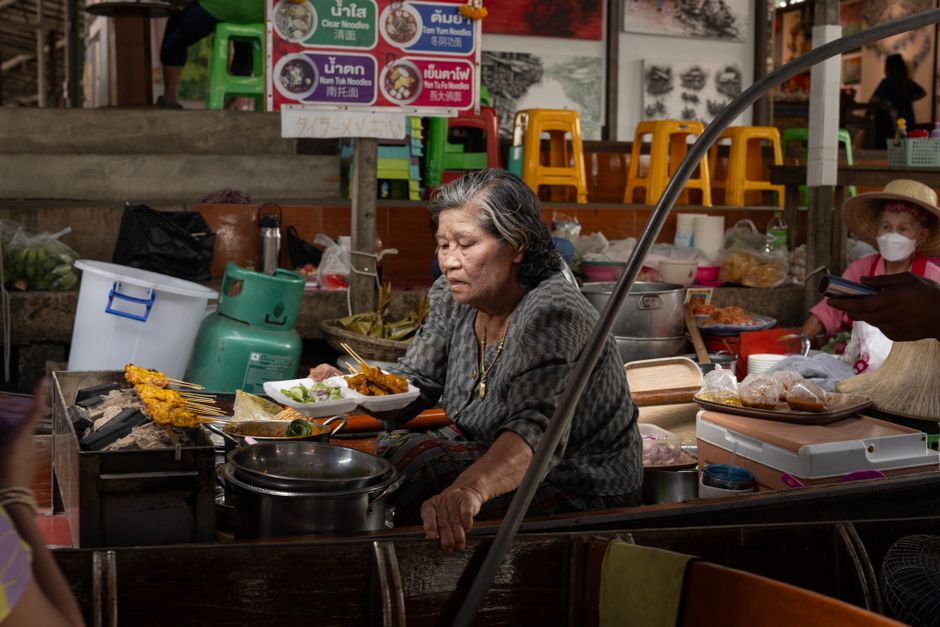
Food markets are arguably the most underused resource in any traveler’s toolkit. Not the artisan food markets staged for tourists with tiny portions and large prices, but the actual working markets where local families buy their produce, butchers hang their cuts, and women with folding tables sell homemade tamales or fresh dumplings from a covered stall in the back.

These markets almost always have an eating section — sometimes called a food court, sometimes just a cluster of stalls — where you can eat incredibly well for very little money alongside the people who actually live there. La Merced in Mexico City serves pozole and huaraches for under three dollars. Mercato di Porta Palazzo in Turin has Senegalese, Moroccan, and Piedmontese food stalls side by side, all feeding the neighborhood’s working population. Chatuchak Weekend Market in Bangkok has entire sections dedicated to Thai food that visitors almost never find because they stop at the entrance stalls.
The approach here is simple: find the main food market in whatever city you’re visiting, arrive around late morning or lunchtime when it’s busiest, and walk all the way to the back. The stalls closest to the main entrance tend to be the most tourist-aware. The ones tucked in the middle, where the vendors are chatting with regulars rather than calling out to passersby, are where you want to sit down.
Use Google Maps Like a Local Reviewer
Google Maps is a genuinely powerful food-finding tool when you know how to use it correctly. The trick is to filter reviews by language. When you pull up a restaurant’s Google Maps listing, scroll to the reviews section and look for the option to filter by language. If a restaurant in Naples has five hundred reviews and four hundred and fifty of them are in Italian, that’s a restaurant Italians are choosing to visit and then going home and writing about in their native language. That matters.
Contrast that with a restaurant where every review is in English, German, or French — languages belonging to tourists rather than residents. Those reviews tell you a lot about the tourist experience but nothing about whether the food is actually good by local standards.
You can also use Google Maps to search specifically in residential neighborhoods away from the tourist center. Zoom into a neighborhood that looks like it has apartment buildings and schools rather than hotels and souvenir shops, then search for restaurants. Sort by rating and look at who’s reviewing them. This is how you find places like a tiny Sichuan restaurant in an unremarkable strip mall in Chicago that has a four-point-eight rating with six hundred reviews almost entirely in Mandarin, or a family-run Greek taverna on the outskirts of Athens that no travel blogger has ever written about but that every Athens local seems to know.
Learn Five Words in the Local Language
You don’t need to be fluent. You don’t need to spend weeks studying. But learning five specific words before you arrive in any country will open doors that stay firmly closed to the traveler who only speaks English loudly and hopefully.
The five words are: hello, please, thank you, delicious, and one more dish. That last one might be a phrase rather than a word — “uno más,” “encore un,” “ひとつもっと” — but the principle is the same. When you greet someone in their language, say please and thank you in their language, and then express genuine delight in their food and ask for more of it, you are communicating something that goes beyond the words themselves. You are saying: I am here as a guest, I respect your culture, and I think what you made is wonderful.
This matters practically because restaurant owners and stall vendors who see you as a respectful visitor rather than a transaction will often do things for you that aren’t on any menu. They’ll tell you what’s fresh today. They’ll bring you something they’re proud of. They’ll point you toward their cousin’s place two streets over that serves something even better on Thursdays. Kindness and basic linguistic respect cost nothing and return enormous dividends in authentic food experiences.
Book a Local Food Tour Before You Go It Alone
If you’re arriving somewhere completely new and want to shortcut the learning curve, one of the smartest things you can do is book a food tour with a local guide on your first full day. Platforms like Viator and GetYourGuide host hundreds of neighborhood food tours in cities around the world, led by residents who genuinely love their local food culture and know exactly which stalls, markets, and family restaurants are worth your time.
A good food tour does three things at once: it feeds you exceptionally well, it teaches you the visual and cultural cues to look for on your own, and it gives you a mental map of which neighborhoods to return to. After a three-hour street food tour through Penang‘s Georgetown neighborhood or a market tour through Bologna‘s Quadrilatero district, you’ll have a completely different sense of where to eat for the rest of your trip. You’ll know which lane has the best char kway teow, which deli has been slicing mortadella since 1967, and how to tell the difference between a restaurant that earns its reputation and one that simply charges for it.
When choosing a tour, look for small group sizes (eight people or fewer), local guides rather than agency employees, and itineraries that include neighborhoods outside the tourist center. Read the reviews carefully and look for comments that mention specific dishes, prices, and genuine local spots rather than vague praise about how fun the guide was.
Put It All Together
Finding authentic local food isn’t about being a food snob or avoiding anything that tourists also happen to enjoy. It’s about eating food that was made with care, for people who know the difference, using ingredients someone sourced that morning from a market down the road. The restaurants and stalls that fit that description are almost never the ones with photos on the outside menu, laminated in six languages, positioned twenty meters from a cathedral. They’re the handwritten chalkboard around the corner, the market stall in the back row, the noodle shop with no English on the sign and a line of office workers waiting patiently at noon. Walk a little further, pay attention to the signs, learn five words, and let Google Maps and a great local food tour show you the rest. Your next truly memorable meal is already out there waiting — you just have to be willing to walk past the obvious to find it. Browse our recommended food tours at FoodTourTrails.com and start planning the kind of trip where every meal becomes a story worth telling.
Book a Food Experience in Top Destinations
Handpicked experiences — book with free cancellation and instant confirmation.
Explore More Food Tours
Guides for the cities in this article:
- Chicago Food Tour Guide (USA)
- Palermo Food Tour Guide (Italy)
- Istanbul Food Tour Guide (Turkey)
- Naples Food Tour Guide (Italy)
- Tokyo Food Tour Guide (Japan)
- Oaxaca Food Tour Guide (Mexico)
Frequently Asked Questions
How do I know if a restaurant is actually popular with locals and not just decorated to look that way?
Check if the menu is in the local language only or prominently features it—tourist traps typically have English translations and pictures. Look for busy lunch hours when locals eat, not just dinner crowds, and observe if families and working people are dining there rather than only foreign visitors.
What's the best way to find hidden local food spots if I don't speak the language?
Use Google Maps to search for restaurants in residential neighborhoods away from tourist centers, then check recent photos from locals (not just official ones) to see if tourists dominate. You can also ask hotel staff who actually live in the area or use apps like Yelp filtered by local reviews rather than traveler ratings.
Are street food vendors safer to eat from than established restaurants?
Yes, typically street food is very safe because of high turnover and visible cooking—avoid vendors with slow business or food sitting out. The key is choosing vendors with long queues of locals, which guarantees freshness and indicates the food is authentic and trusted by the community.
How can I tell if a 'traditional' dish is actually traditional or invented for tourists?
Ask locals directly which dishes are essential to their region's cuisine, and cross-reference by visiting multiple family-run restaurants to see what appears consistently on menus. Be suspicious of heavily modified versions or dishes that seem too Instagram-friendly—authentic local food prioritizes flavor and tradition over presentation.
What price range should I expect for authentic local food?
Authentic local restaurants typically cost 30-50% less than tourist-oriented establishments and rarely have prices in multiple currencies displayed prominently. If a casual restaurant's prices are comparable to or higher than fine dining in your home country, it's likely catering to tourists rather than locals.